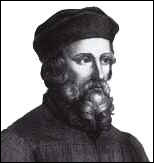
 The Goose and the Gospel
Jan Hus, 1380-1415
He's not the most popular reformer out there. In fact, his memory lives in the shadow of his own successors Luther, Calvin, and Zwingli. Some may not even wish to call him a "reformer" seeing as how he died a century before anything sparked the movement we know as the Reformation. Yet, I hope that a brief recounting of his story will show a couple of things in light of this year's Reformation Day:
1) God keeps people for himself in every generation, despite the dark clouds that well up and try to blot out the glory of the gospel in some eras.
2) The sovereignty of God in bringing about the Reformation.
Jan Hus was born a Bohemian (modern-day Czech Republic) in 1371
[Important: "Hus" is the Bohemian word for "goose", and he referred to himself as such, as did his friends]. Though he was born a peasant, he pursued a path in higher education and enrolled at the University of Prague where he received a masters degree in 1396, became professor of theology in 1398, and was ordained to the priesthood in 1400. This time period was actually quite messy for the Roman Catholic church, for this is when "The Great Schism" took place.
The schism describes a split in the authority of Roman Catholicism. Under pressure from the King of France, the seat of the Popes was moved the Avignon France where it remained for 70 years (now called the "Babylonian Captivity" of the church, referring to the 70 years that the Jews were enslaved to the Babylonians). In 1376, the pope returned to Rome and died. Thus, his accompanying
French cardinals were pressed to elect another pope. However, feeling the pressure from the citizens of Rome, they elected an
Italian pope. Afterward, they fled and denounced their decision claiming they were under pressure; therefore, their papal election was void. From France, they then elected another pope who was
French. Now there were two popes, and to settle the matter they arranged the Council of Constance. At the council, they elected
another pope...hoping the other two would step down (which they did not do). Therefore, the successor of the third pope - Pope John XXIII - decided to subdue his rivals by force. In order to do this, he would have to raise money for a war effort to supply his men with weapons, armor, etc. He chose as his fundraising method the selling of indulgences; that is, if one pays enough money, he/she can buy spiritual blessings. The selling of indulgences was rampant and Hus was not about to tolerate it.
(During this time it is important to note that Hus had been greatly affected by the writings of John Wycliffe...another pre-Reformation reformer). Hus spoke out against the indulgences and other Roman Catholic practices, such as the belief that the pope was God's divinely appointed head of the church. Being he was a respected professor and well-loved priest, his audience was not small. His decryings of the pope's evils made so much noise that he himself was summoned to appear before the Council of Constance to give an account for his "blasphemous" teachings. They granted him safe passage even if he was found guilty; thus, he came before the Council.
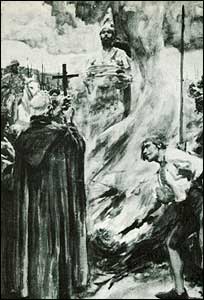
However, his enemies lied and when he would not recant, they chained him up, and paraded him through the streets as a heretic. Shortly thereafter, Jan Hus was burned at the stake for his teachings.

But before his captors could shut him up with the fire, as he was singing hymns, he also made this prophetic announcement (as quoted by one of his onlooking opposers):
"You are now going to burn a 'goose', but in a
century you will have a swan, which you can neither roast nor boil." The year...1415.
One hundred and two years later, Martin Luther nailed up his 95 theses in Wittenburg, Germany...sparking the Reformation. For many, the swan spoken of by Hus is Martin Luther; one who the authorities could not silence.
Whether or not Hus was prophetic is not the point. The point is, Christ has kept for himself believers in every generation, using them to strengthen and teach one another (i.e. - Wycliffe and Hus, Hus and Luther). And how God willed the burning of a 'goose' that led to the singing of a 'swan'. Thank God that he preserves his gospel throughout history in order to save those whom the Father has given to the Son.
Happy Reformation Day.

 The Goose and the Gospel
 But before his captors could shut him up with the fire, as he was singing hymns, he also made this prophetic announcement (as quoted by one of his onlooking opposers):